Showing posts with label nursing. Show all posts

9.01.2010

It's September (Part 2)

Looking back fondly on last year and my first published nursing "article", I present you with the actual text of the piece I wrote almost two years ago. It's fairly short, but I was absurdly proud of it at the time. Enjoy a small slice of my history.

September: Prostate Cancer Awareness Month

Introduction

It’s September and the smells of football, barbecue, and beer fill the air. Probably the last thing on your mind is your prostate, but according to the American Cancer Society, one in every six men will have prostate cancer in his lifetime (American Cancer Society [ACS], 2008). That’s better than Auburn’s chances of winning a National Championship, so we should probably turn our attention, at least for a moment, from SportsCenter to prostate health.

Explanation and Risk Factors

The prostate is a small gland located just in front of the rectum that contributes to the production of seminal fluid. Only men have prostate glands, and therefore, only men can have prostate cancer. With cancer of the prostate, the cells multiply out of control due to a genetic abnormality and can spread to other parts of the body invading other tissues where they begin to interfere with the body’s normal function. Frequent urination can be merely a symptom of the mass amount of alcohol fans consume on game days, but if you’re over 55 and trips to the restroom extend past the weekends and begin to interrupt your week, you might want to think about heading to your doctor for an exam because this could be a symptom of highly developed prostate cancer (ACS, 2008). However, early prostate cancer generally doesn’t have many obvious symptoms, so if you’re in your late fifties and at high risk it’s a good idea to get a regular exam even if there don’t seem to be any signs of the disease (Smith et al., 2002). Cancer of the prostate occurs most frequently in men in their mid-to-late fifties, and is especially prevalent in African-American populations and those with a family history of prostate cancer (ACS, 2008).

After Diagnosis

If you are diagnosed with prostate cancer there are many options and courses of action you can take. First, the cancer must be staged to determine tumor size and spread, presence in the lymph nodes, and whether the cancer has metastasized, that is, moved to other parts of the body. Once it has been staged, you and your doctor can determine the best treatment plan for you. If caught early on, one common route is the “watchful waiting” method that requires no active treatment unless symptoms develop and the cancer grows. This option allows patients, under careful screening, to continue with their daily activities without the risks of surgery. It is good to know that the survival rate of prostate cancer has greatly increased in the past couple of years but, without early detection, this cancer can require a radical prostatectomy, which involves the removal of the prostate and surrounding tissues, or, if it spreads, can lead to death (National Cancer Institute [NCI], 2000).

Conclusion

So, what can you do if you are at high risk? Please visit and talk to your physician soon. There are many doctors in the area that can perform a simple Digital Rectal Exam to determine if further tests might be needed. In addition, the East Alabama Urology Associates in Opelika offers the services of two expert physicians who specialize in men’s health (East Alabama Urology Associates, 2000). Alright, you can turn the television back on. It’s September, and I hope this year, with the smells of football, barbecue, and beer, you’re thinking, “War Eagle. It’s about time for my prostate check-up.”

7.31.2010

Therapeutic Communication

Dr. Libba McMillan was my favorite teacher in nursing school. A lot of students didn't like her because she didn't always teach the classes with the most "content." She didn't teach us clinical physiology, clinical practice techniques, or even fundamental nursing procedures, but taught us something much more important: therapeutic communication.

I think that therapeutic communication is the difference between a good nurse and a great nurse. Therapeutic communication is the most essential aspect of a patient-health care provider relationship. Without it, the best doctor or nurse is absolutely, well, useless.

Therapeutic communication, in addition to being the most important thing I developed for my nursing career, has been invaluable in relationships with my friends, family, and even strangers.

Here are just a few points on therapeutic communication from my study book for my nursing licensing exam. Actually, these are the only points on therapeutic communication included. It says:

Therapeutic Communication

Nonverbal interaction:
-May be more important than verbal communication
*(I personally think nonverbal interaction can drastically impact the nurse-patient relationship far more than verbal communication).
Verbal communications:
-Promote insight and help client to problem solve
-Must keep client as focus
-Allow clients to make choices
-JUST FACTS!
-Use matter-of-fact approach

A couple points that I remember, and have paraphrased, from Dr. McMillan's class:
  • Ask open-ended questions, that is, ones that can't be answered with a yes or no answer.
  • Never ask a patient why they did or didn't do something. "Why" questions are judgmental questions. (This is one of the hardest techniques for me to use).
  • If you ask a patient, or friend, a question and you really intend to have them give you an answer wait in silence a little while until they answer.
  • Don't walk out of the room while asking questions or talking to a client.
  • If a patient is upset and cries you don't have to say anything. Your presence is enough. Sometimes it's even okay to cry with them.
  • Speak on their level. That doesn't just mean explaining things in layman's terms. Actually bend down to talk to them. If they are sitting in the bed squat or sit nearby in order to talk to them while maintaining eye contact.
  • Normalize the client's feelings, symptoms, and understanding. This also helps when interviewing a patient about uncomfortable subjects, e.g. "Many patients who take diuretics experience erectile dysfunction. Is this something you've experienced?"
  • Acknowledge and directly address a client's confusion, fear, or other feelings regarding a diagnosis or procedure, e.g. A patient's wife complains that she is so exhausted from caring for her terminally ill husband. Don't say, "Well, you don't have to worry now. We will take care of him." Rather, try something like, "I can imagine you must be really exhausted from caring for your husband. Would you like to talk about it?"
  • Finally, listen to your patients. They will tell you what is the matter with them. (Simply listening is one of the best tricks for a fruitful friendship).
Overall, therapeutic communication interests me very much. I wonder how many of these strategies we employ each day without even knowing it.

Do you find yourself ever using these therapeutic communication tools? If not, do any of them seem valuable to you?

5.14.2010

When did this happen?

I am graduating tomorrow.

Well, really, today (it's after midnight).

WHAT?!?! When did this happen to me?

3.19.2010

I'm so tired but I can't sleep...

...to quote Sarah McLachlan.

Tonight will be my third night of seven in this week's hospital schedule. My shift is from 11PM to 7AM and has been absolutely draining me.

Last night/this morning I was useless at work. I walked and talked and felt like a zombie. I didn't get a lot of sleep the day before, so I was especially tired when I got home this morning.

But, guess what? I couldn't sleep well again. I woke up around noon for a while, and then again several times throughout the afternoon. I think if I didn't have to wake up to turn in my log by 5PM I could have been able to sleep for a while longer. But, alas, it was not so. After being awake for that little while, all abilities to return to that blissful sleep state have vanished. For the last hour plus I have been laying in my bed trying desperately to fall asleep again. But, guess what? I can't.

What is the matter with me? I really enjoy the nursery normally, but without sleep it can be extremely exhausting.

Please pray for me. My circadian rhythm is way off, and I've been experiencing all the symptoms of jet lag without the pleasures of actually being on vacation.

2.26.2010

Amazon book addiction

I might be addicted to amazon.com.

I just love how I can sit on my bed and order gobs and gobs of books with a few clicks.

This had led to some pretty bad things. I have ordered an excessive amount of books online. I just love them. I love coming home, opening up the package, and diving into my new book.

I just ordered John Stone's In the Country of Hearts. Yes, John Stone is currently my poet obsession, and I just couldn't resist the book after reading a couple editorial reviews. It's not poetry, but rather a narrative account of his experiences as a physician. And, come on, this has to count as "nursing research" because of the subject matter. I am sure I will learn many things, and really enjoy reading this book.

I'll let you know when I get it and start reading!


2.15.2010

HESI-Pass

I just passed my HESI.

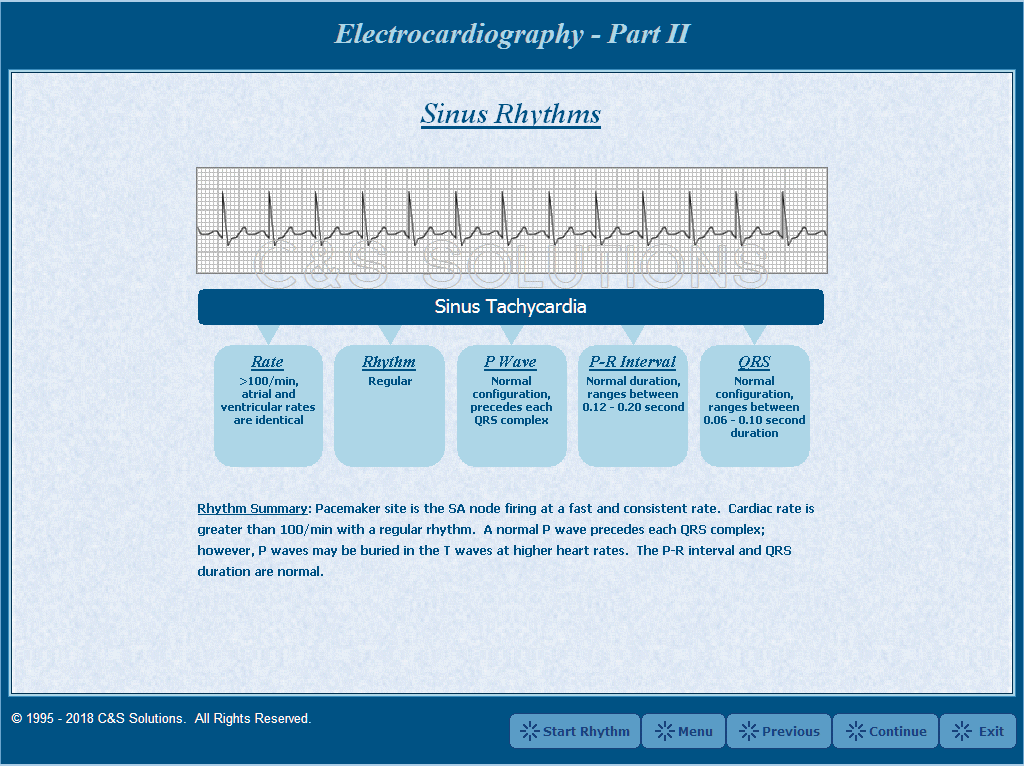
I may or may not have been severely tachycardic during the last 10-15 minutes. Luckily, it was sinus tachycardia not ventricular tachycardia so there was no reason to resuscitate me in the computer lab.

I am done. Essentially, by passing this test I just graduated. It feels pretty good.

All glory to God!

9.21.2009

Lifelong Learning

I am a huge proponent of lifelong learning. I think that each day, and its new experiences, provides an opportunity to learn more. 

I just read the most fascinating news about the ability to learn throughout one's lifetime despite factors that might suggest learning is no longer possible. 

If this interests you, please read this article

I am interested about what sort of "profound implications," as Dr. Berkinschetein says, there will be for neuroscience, medical care, and all those who are involved in making end-of-life decisions. Could these implications force us to better define life, and what it means to be "conscious," or will they drag us deeper down into our god-complexes, and further our illusions that being able to predict a patient's recovery or death equals actually having the power to grant life or death? 

I'm not sure how much press this small study will get, or how profound its implications will turn out to be, but I do know that it makes me feel foolish for grumbling about my exams and having to show what I have learned while patients in a vegetative state are fighting, in the only way they know how, to prove that they can learn, and are, indeed, not so vegetative after all.

8.26.2009

Nursing: A Science and an Art

I used to have this terrible perception of nurses. I thought that people who chose nursing were med-school rejects, those not willing to work hard enough, those too scared to be doctors. I used to think that.

I first became interested in Nursing as a career in 2004. I was in Mexico, where I fell in love with mission work and vowed to return again and often to help the people who I had grown to love so much. However, the unique opportunity to go as a high school student was just that, unique. While still in the Yucatan I began looking for a way to return. I decided I needed a skill, and since I'm not that strong, relatively, I figured it needed to be more scientific-based.

Each year the Archdiocese of Mobile sends a group of teenagers to Akil, Mexico to give aid and love to the people. Each year they take a "medical team". It usually consists of a doctor and a nurse, but in 2004 the Archdiocese was unable to send a physician, so they sent two nurses instead. While there I got assigned to work with the "medical team" and visit the people in need. I was so impressed with the special way the nurses were able to interact with the patients. The wheels started turning in my head.

In 2006, when I discerned that I was to attend Auburn University, I knew I needed to pick a major. Still on fire with my desire to return to Mexico I decided on Nursing. When I applied in 2008 I had a lot of doubts. You see, I wasn't particularly good at Nursing essentials like Anatomy and Physiology, and Microbiology. Still, when I got accepted, I felt that God was not opening up other doors for me, and this one was wide open.

With essentially a semester left in Nursing School, I reflect on my experiences and realize they have mostly been difficult. It is draining work, that is rarely as rewarding as the amount of effort I put in. It has broken me. Repeatedly.

Still, there are times when I do remember why nursing is beautiful, unique, and not just for women who are too afraid or too dumb to become doctors.

What do nurses really do other than empty bed pans, give medications, and take vital signs? I think it's a common misconception, that I myself bought into, that nurses are merely glorified maids, or essentially physician's handmaidens. However, I have come to understand and know that nursing is both a science and an art. The purpose of Medicine is to treat diseases. The purpose of nursing is to treat human responses to diseases. Physicians see sick bodies. Nurses see sick bodies, sick minds, and sick souls. Nursing is unique in it's holistic approach to healing.

Nurses diagnose. Did you know that? We don't make medical diagnoses, but we have nursing diagnoses which help us to see what's really keeping a sick person sick, and help us to make them well. These diagnoses go beyond "Diabetes," "Congestive Heart Failure," and "Lyme Disease." Nursing diagnoses look at, "Knowledge deficit related to new diagnosis of diabetes," "Ineffective tissue perfusion related to congestive heart failure," and, "Fatigue and poor self image related to lyme disease."

There are several nursing theorists, and each novice nurse begins to adopt her own theory for taking care of the sick. Mine is loosely based on the theory of Dorthea Orem who identified that patients "wish to care for themselves", and will have better outcomes if they are taught how and encouraged to care for themselves as much as possible. Essentially, "Give a man a fish, and feed him for a day. Teach a man to fish, and feed him for a lifetime."

Nurses are teachers, patient advocates, case managers, researchers, leaders, and counselors. We fight for the rights and well-being of our patients. We see the pain, the fear, and the life in our patients. We help to provide dignity and peace to the ill and the dying.

As nurses we have our weaknesses too. We fight relentlessly with physicians, respiratory therapists, pharmacists, and lab technicians. We demand the best care and respect for our patients. We know our patients, and because we know them, we find it impossible to separate our emotions from a case. We listen, we feel, and we cry.

Some days I don't feel any of this. Some days I come home from the hospital and want to ball up and cry. Most days I do. More often than not you might hear me whining about my long day, my long classes, and my ridiculous assignments. But some days, every now and then, I remember what I am a doing, and Who I am serving.

I have chosen a profession where I have every right to pray with a patient. I get to hear what a patient really thinks and feels when the physician leaves the room. I watch as a patient finds out he needs open heart surgery, tomorrow. I give a two-hour old baby her first bath. I get to hold the hands of cancer, look into the eyes of pneumonia, and listen to the heart of end-stage renal disease, and I know that when a monitor flat-lines the soul lives on.

I may grumble, whine, and cry, but today, and every day I care for a patient, I am a scientist and an artist, and I am making a difference.

Fiat!